 ernster.dev
 Decision Architecture
The core of my work: a thesis on the structural design of decision-making, together with the software and instruments that make it executable.
The model runs
Organisational theory has a recurring weakness: it cannot be run. This one can. Decitect scores any organisation's structural health deterministically from 0 to 100: there is no randomness, so two people with the same model get the same number and every claim can be checked by anyone with the tool.
Typical organisation archetypes collapse as they grow. The constraint is real; no amount of design abolishes it.
Well-designed archetypes under that same growth degrade gently instead; the scale band leaves them untouched because they hold no concentration for it to price.
On the enterprise archetype, adding one approval layer costs most of what the strongest repair available to it earns.
The median best local move dwarfs the best whole-organisation move, which is why the tool lets you drill into a section and work its own move space.
Each of these is a measured result rather than an assertion; the figures behind them are published where they are produced rather than restated here: Decitect's own pages carry the scores, the deltas and the seeds that reproduce them. The claims are falsifiable by design: model a realistic organisation in which adding an approval layer improves structural health and the framework is wrong in a way anyone can inspect.
 Decitect ↗
The model made executable. A chess-like board that scores organisational structure and valuates every move, from blunder to great; its guide plans every level of a six-thousand-person enterprise at once, across all but one processor core, then composes the leaf repairs into an honest whole-organisation climb.
Decitect ↗
The model made executable. A chess-like board that scores organisational structure and valuates every move, from blunder to great; its guide plans every level of a six-thousand-person enterprise at once, across all but one processor core, then composes the leaf repairs into an honest whole-organisation climb.
 Simquence ↗
A design-time latency simulator for event-driven systems. Deterministic and seeded, it prices the cost of structure before it hardens.
Simquence ↗
A design-time latency simulator for event-driven systems. Deterministic and seeded, it prices the cost of structure before it hardens.
 crankthecode.com ↗
The thesis in long form: how the structure of decisions governs whether systems and organisations succeed or fail.
crankthecode.com ↗
The thesis in long form: how the structure of decisions governs whether systems and organisations succeed or fail.
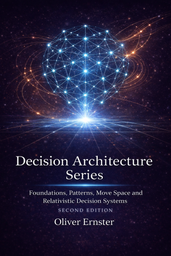 Decision Architecture series ↗
Four books covering the foundations, patterns, move space and relativistic systems of organisational decision-making.
Decision Architecture series ↗
Four books covering the foundations, patterns, move space and relativistic systems of organisational decision-making.