Fancy Clock app icon
Windows 路 macOS 路 Linux

Fancy Clock

A calm desktop clock that stays out of the way. Analog or digital, with alarms, automatic timezone localization, animated skins and adjustable opacity, so the time is always there without ever demanding attention.

Free and open source. Local-first. No account, no telemetry, no cloud.

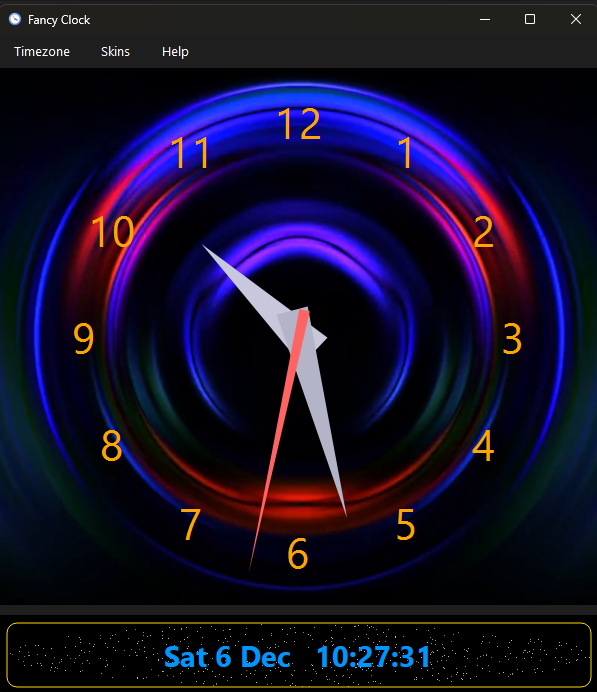
Fancy Clock running on the desktop in analog mode with an animated skin behind the dial
Analog mode with an animated skin behind the dial.

Most desktop clocks are either a bare number in a tray or a heavyweight widget that clutters the screen. Fancy Clock is a clock you actually want on the desktop: frameless, draggable, dimmable and quietly correct about the time, wherever in the world you are.

What Fancy Clock does

A focused set of things a desktop clock should get right and nothing it should not.

Analog and digital modes

Switch between a clean sweeping analog dial and a crisp digital readout. The mode you pick is remembered between sessions.

Automatic timezone localization

Reads your system timezone and shows the correct local time, with region and city names translated into your own language.

Accurate to real time

An optional NTP time source keeps the display honest, so the clock is right even when the machine clock has drifted.

Animated video skins

Nine backdrops from a subtle Starfield to a spinning galaxy, waves and a wormhole. Or run it plain and quiet.

Frameless and draggable

No title bar, no chrome. Grab it anywhere and place it exactly where you want it on any monitor. A single instance, never a stack of windows.

Adjustable opacity

Dim the clock from solid down to a faint overlay with the View menu slider, Ctrl with the arrow keys or Ctrl with the mouse wheel; your level is remembered. Available on Windows and macOS.

Alarms that behave like a phone's

Weekly or one-off alarms with labels, colours, five sounds, snooze budgets and a missed-alarm summary. Set on a clock-face picker; runs from the system tray.

Proper alarms, on your desktop

The alarm experience you expect from a phone, without the phone.

The Fancy Clock alarm editor with a clock-face time picker, weekday chips and colour swatches
The alarm editor: clock-face picker, weekday chips and colours.

Set it like a clock

Pick the time on a clock-face dial or type it. Repeat on any weekdays or fire once on a chosen date, in any timezone you like.

Snooze on your terms

Per-alarm snooze from 5 minutes to 24 hours, a budget of 1, 3, 5 or unlimited snoozes per ring and a re-pickable duration every time you snooze.

Five sounds, your colours

Beep, Chime, Bell, Pulse or Marimba, previewable in the editor, with a colour per alarm so you know which one is ringing at a glance.

Lives in the tray

Close to the system tray and the alarms keep watching. The tray shows your next alarm; an optional setting starts Fancy Clock when you sign in.

Never silently loses one

Machine asleep or the app closed when an alarm was due? You get a missed-alarms summary the moment it is back, every time. If the saved alarms file is ever damaged, you are told how many entries could not be read rather than left to find out by oversleeping.

Honest about time

Alarms fire on the same NTP-corrected time the clocks display and daylight-saving transitions are handled correctly, not approximately.

Nine skins, one clock

Pick a mood. Every skin sits behind the same clear dial and your choice is saved.

Starfield

Mesmerize

Spinning Galaxy

Wormhole

Waves

Spiral

Spiral Clock

Flower Tunnel

Fancy Circles

Speaks your language

The interface and the timezone names are translated across more than 70 languages and over 240 regional locales, from Arabic and Bengali to Vietnamese and Welsh. Numbers follow your locale too. Fancy Clock picks the right one from your system automatically; you can override it whenever you like.

Why this exists

A clock on a desktop has one job and most of them do it either too loudly or not at all. A tray digit is easy to miss; a busy widget is easy to resent. Neither is calm.

Fancy Clock is built around letting you choose how present it is. Run it plain and faint so it disappears into the wallpaper. Or give it an animated skin and let it be the boldest thing on the desktop. Either way it is frameless so it blends in, dimmable so it never has to compete with your work and correct about the time and the timezone, so you can trust a glance instead of a double-check.

It is the clock I wanted on my own desktop: something pleasant to look at, honest about the time and happy to fade into the background until the moment I need it.

Full reasoning at crankthecode.com.

Frequently asked questions

Is Fancy Clock free?

Yes. Fancy Clock is free and open source, released under the GNU LGPL-3.0 licence.

Does Fancy Clock work offline?

Yes. It is local-first and everything works offline. Its only network use is fetching accurate time from an NTP server at startup and an anonymous daily check of GitHub releases for a newer version; both fail silently when no network is available.

Which platforms does Fancy Clock run on?

Windows, macOS and Linux, from a single PySide6 codebase. Windows ships as an installer, macOS as a DMG and Linux as a Flatpak.

Can I make the clock semi-transparent or keep it out of the way?

Yes, on Windows and macOS. A slider in the View menu dims the window from fully solid down to a faint overlay, also adjustable with Ctrl and the Up and Down arrows or Ctrl and the mouse wheel. Your level is remembered between sessions. On Linux the app ships as a Flatpak, whose sandbox cannot set per-window opacity, so the control is not available there.

Does it handle different timezones and languages?

Yes. Fancy Clock detects your system timezone and language, shows the correct local time and translates region names and numbers across more than 70 languages and 240 regional locales.

Does Fancy Clock have alarms?

Yes. Weekly-repeating or one-off alarms with labels, colours, five sounds, per-alarm snooze durations and snooze budgets, set on a clock-face time picker. The app can live in the system tray and optionally start when you sign in. Anything that fired while the machine was asleep or the app was closed appears in a missed-alarms summary.

Will an alarm wake my computer from sleep?

No, deliberately. Fancy Clock never wakes a suspended or powered-off machine. If an alarm's time passes while the machine is asleep, it rings on wake when recent or is reported in the missed-alarms summary.

Runs everywhere, stores nothing remotely

One PySide6 codebase, native on all three platforms. Nothing about you ever leaves the machine.

Windows

Installer (.exe)

macOS

DMG

Linux

Flatpak

Get FancyClock

Download FancyClock

Pick your platform and you have the newest release. Free and open source under the LGPL-3.0 licence, local-first with no account, no telemetry and no cloud.

Latest release
馃獰

Windows

Windows 10 or 11, 64-bit

Download for Windows

Setup wizard (.exe)

Windows may show a SmartScreen warning when you run this: here's why.

Per-user install, no admin needed. Uninstall any time from Settings > Apps.

馃崕

macOS

Apple Silicon

Download for macOS

Disk image (.dmg)

Open the DMG and drag Fancy Clock to Applications.

馃惂

Linux

Any distribution with Flatpak

Download for Linux

Flatpak bundle (.flatpak)

Install with flatpak install FancyClock.flatpak.

Fancy Clock is a free, private, local-first desktop clock for Windows, macOS and Linux. It offers analog and digital modes, alarms with snooze budgets, colours, five sounds and a missed-alarms summary, automatic system timezone localization with region names and numbers translated across more than 70 languages and 240 regional locales, optional NTP time accuracy, nine animated video skins including Starfield, adjustable window opacity with a View menu slider and keyboard and wheel shortcuts, a system tray mode with optional start at sign-in and a frameless draggable window. Built with Python and PySide6, it works fully offline with no cloud dependency (its only network calls are an NTP time query at startup and an anonymous daily update check against GitHub releases) and is open source under the LGPL-3.0 licence.